



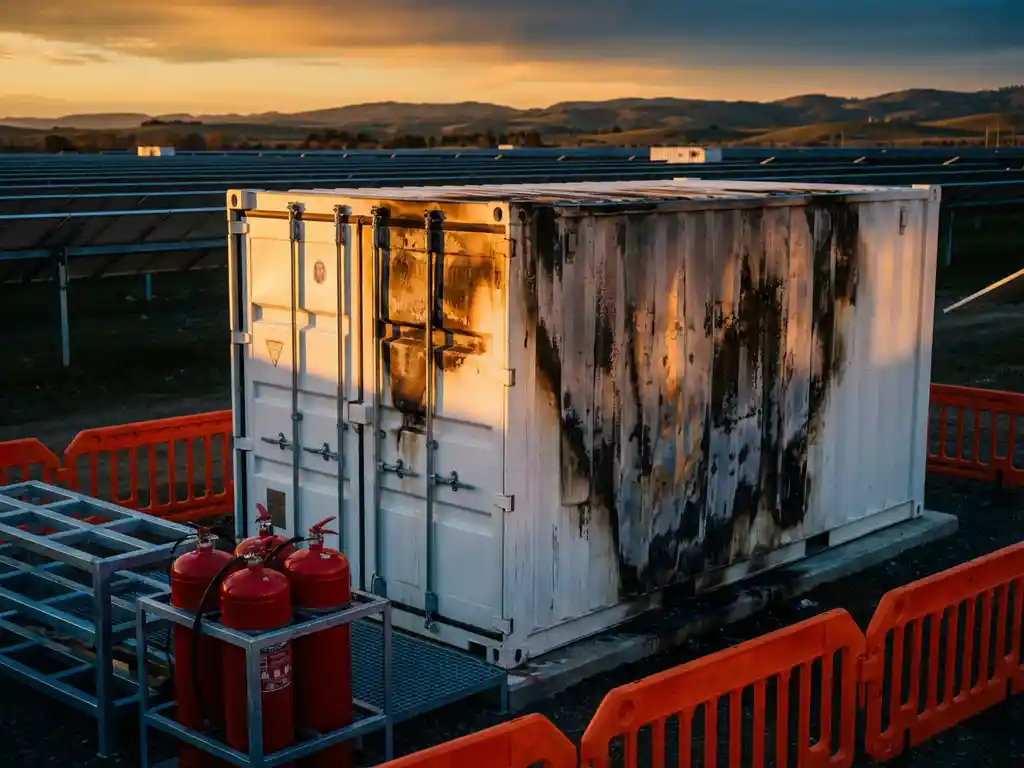
How does fire risk impact BESS insurance premiums?
Battery Energy Storage Systems (BESS) are becoming essential infrastructure for renewable energy projects, but they come with unique fire risks that can significantly impact insurance premiums. Fire incidents at battery storage facilities can lead to catastrophic losses, making insurers particularly cautious when assessing BESS insurance applications.
Understanding how fire risk affects BESS insurance costs is crucial for project developers, investors, and operators planning energy storage investments. The relationship between fire safety measures and insurance premiums can make or break the financial viability of battery storage projects.
What is fire risk in BESS, and why do insurers care?
Fire risk in BESS refers to the potential for thermal runaway events in which battery cells overheat, ignite, and spread fire throughout the storage system. Insurers care deeply about this risk because battery fires can cause complete facility destruction, extended business interruption, and liability claims exceeding hundreds of millions of dollars.
Thermal runaway occurs when battery cells reach critical temperatures, triggering a chain reaction in which neighboring cells also overheat and ignite. This process is particularly dangerous because it can happen rapidly and is difficult to extinguish once it starts. The high energy density of modern battery technologies means that even small incidents can escalate quickly into major fires.
Battery fires present unique challenges compared to traditional electrical fires. They burn at extremely high temperatures, can reignite hours or days after appearing to be extinguished, and produce toxic gases that pose health risks to emergency responders. These characteristics make BESS fires among the most expensive industrial incidents to manage, both in terms of direct property damage and business interruption costs.
Insurance companies view fire risk as the primary threat to BESS investments because it represents both high-probability and high-impact scenarios. Unlike other renewable energy technologies, battery storage systems operate continuously with frequent charge and discharge cycles, creating multiple opportunities for thermal events to occur.
How do insurers assess fire risk when pricing BESS premiums?
Insurers assess fire risk through comprehensive technical evaluations that examine battery chemistry, thermal management systems, fire suppression capabilities, and operational protocols. They typically require detailed engineering reports, safety certifications, and operating procedures before determining premium rates for BESS projects.
The assessment process begins with an evaluation of the battery technology. Insurers examine the specific chemistry used, as different lithium-ion technologies have varying thermal runaway characteristics. They review manufacturer safety data, testing certifications, and any history of thermal events involving similar battery systems.
Thermal management systems receive intense scrutiny during risk assessment. Insurers evaluate cooling system design, temperature monitoring capabilities, and emergency shutdown procedures. They look for redundant cooling systems, comprehensive sensor networks, and automated response protocols that can detect and respond to temperature anomalies before they escalate.
Fire suppression systems are another critical assessment factor. Insurers prefer installations with advanced suppression technologies specifically designed for battery fires, such as specialized chemical agents or immersion cooling systems. Traditional sprinkler systems alone are often insufficient for battery fire scenarios.
Operational factors also influence risk assessment. Insurers review maintenance protocols, staff training programs, and emergency response procedures. They may require regular thermal imaging inspections, preventive maintenance schedules, and coordination with local fire departments familiar with battery fire response.
Which battery technologies have the highest fire risk premiums?
Lithium-ion battery technologies with higher energy densities typically carry the highest fire risk premiums, particularly nickel-based chemistries such as NMC and NCA. Lithium iron phosphate (LFP) batteries generally receive lower premium rates due to their superior thermal stability and lower fire risk profile.
Nickel manganese cobalt (NMC) and nickel cobalt aluminum (NCA) batteries present elevated fire risks because they contain more reactive materials and operate at higher voltages. These chemistries can experience thermal runaway at lower temperatures and propagate fire more rapidly between cells. Insurance premiums for these technologies can be significantly higher, sometimes doubling baseline rates.
Lithium iron phosphate batteries are favored by insurers because they demonstrate better thermal stability and are less prone to thermal runaway events. LFP batteries require higher temperatures to initiate thermal runaway and burn less intensely when incidents do occur. This improved safety profile often translates to premium discounts of 20% to 40% compared to higher-risk chemistries.
Emerging battery technologies such as solid-state batteries may receive premium penalties initially due to limited operational data and unknown risk factors. Insurers typically apply conservative pricing to new technologies until sufficient performance history becomes available to support more accurate risk assessment.
The physical configuration of battery systems also affects premiums. Larger battery cells and modules can create more intense thermal events, while smaller cells may offer better containment but require more complex monitoring systems. Insurers evaluate these trade-offs when determining technology-specific premium adjustments.
What fire safety measures can reduce BESS insurance costs?
Comprehensive fire detection and suppression systems, redundant thermal management, and proper spacing between battery modules can significantly reduce BESS insurance premiums. Advanced monitoring systems that provide early thermal runaway detection often qualify for substantial premium discounts from insurers.
Fire suppression systems specifically designed for battery applications provide the most significant premium reductions. These include clean-agent systems that can suppress fires without conducting electricity, aerosol suppression systems designed for enclosed battery spaces, and specialized cooling systems that can prevent thermal propagation between battery modules.
Thermal management improvements offer another path to lower premiums. Redundant cooling systems ensure continued operation even if primary cooling fails. Advanced temperature monitoring with multiple sensors per battery rack enables early detection of thermal anomalies. Automated shutdown systems that can isolate affected battery sections help prevent incident escalation.
Physical design modifications can also reduce insurance costs. Adequate spacing between battery containers or racks helps prevent fire spread between systems. Fire-resistant barriers and compartmentalization limit the scope of damage when incidents occur. Proper ventilation systems help manage heat buildup and toxic gas accumulation.
Operational measures contribute to premium reductions as well. Regular thermal imaging inspections can identify potential problems before they become thermal events. Comprehensive maintenance programs ensure all safety systems function properly. Staff training on battery fire response procedures helps minimize incident severity and duration.
How much do BESS insurance premiums increase due to fire risk?
Fire risk typically increases BESS insurance premiums by 50% to 150% compared to baseline renewable energy project rates, with exact increases depending on battery technology, safety systems, and project-specific risk factors. Projects with minimal fire protection may face premium increases of 200% or more.
Baseline renewable energy insurance rates for solar projects typically range from 0.2% to 0.4% of insured value annually. For BESS projects, fire risk alone can add 0.3% to 0.6% to these rates, effectively doubling or tripling the total premium cost. High-risk configurations may see even larger increases.
The premium impact varies significantly based on battery technology selection. LFP battery systems might see fire risk premiums of 0.2% to 0.4% of insured value, while high-energy-density chemistries could face fire risk premiums of 0.5% to 0.8% or higher. These differences can amount to hundreds of thousands of dollars annually for large-scale installations.
Investments in safety systems can partially offset these premium increases. Comprehensive fire protection systems might reduce fire risk premiums by 20% to 40%, while basic safety measures typically provide smaller reductions. The cost-benefit analysis often favors investing in advanced safety systems to achieve lower ongoing insurance costs.
Project size also influences premium scaling. Larger installations may benefit from economies of scale in safety systems, potentially reducing per-megawatt fire risk premiums. However, they also face higher absolute risk exposure, which can offset some of these advantages in total premium calculations.
What happens to insurance coverage after a BESS fire incident?
After a BESS fire incident, insurers typically conduct comprehensive investigations, may impose coverage restrictions or exclusions, and often require significant safety upgrades before renewing policies. Premium increases of 100% to 300% are common following fire events, and some insurers may refuse to renew coverage entirely.
The immediate aftermath of a fire incident involves a detailed investigation by insurance adjusters and technical experts. They examine the cause of the thermal runaway event, evaluate the effectiveness of safety systems, and assess whether proper maintenance and operating procedures were followed. This investigation process can take several months to complete.
Coverage decisions for the affected facility depend heavily on the investigation findings. If the fire resulted from equipment defects or external factors beyond the operator’s control, insurers may maintain coverage with modest premium adjustments. However, if investigations reveal maintenance failures or operational errors, insurers may impose significant restrictions or deny future coverage.
Renewal negotiations following fire incidents typically require substantial safety improvements. Insurers may mandate upgraded fire suppression systems, enhanced monitoring capabilities, or changes to operating procedures. These requirements can represent significant additional capital investments beyond the direct fire damage costs.
The broader insurance market often reacts to individual fire incidents by tightening underwriting standards for all BESS projects. Major fire events can trigger industry-wide premium increases and more stringent safety requirements, affecting even facilities with no incident history. This market dynamic makes fire prevention crucial for the entire BESS industry.
How Solarif helps with BESS insurance and fire risk management
We specialize in securing comprehensive insurance coverage for battery energy storage systems while helping clients implement risk management strategies that reduce premium costs. Our expertise in renewable energy insurance enables us to navigate the complex BESS insurance market and secure competitive rates even for high-risk battery technologies.
Our BESS insurance services include:
- Risk assessment and safety system evaluation to identify premium reduction opportunities
- Insurance market navigation to find insurers with BESS expertise and competitive pricing
- Policy structuring that balances comprehensive coverage with cost-effective premiums
- Claims support and incident response coordination with specialized battery fire experts
- Ongoing risk management consultation to maintain optimal insurance positioning
With over 15 years of experience in renewable energy insurance and 3.8 GW of capacity insured, we understand the unique challenges of battery storage projects. Our relationships with A-rated insurers and technical expertise in fire risk assessment help clients achieve both comprehensive protection and manageable insurance costs.
Ready to secure optimal insurance coverage for your BESS project? Contact our renewable energy insurance experts today for a comprehensive risk assessment and a competitive premium quotation.
Insurance and inspection needs for your BESS?
Contact us today if you want to know more about the possibilities in BESS insurance and Scope inspections.
📧 Email: support@solarif.com
☎️ Phone: +31 (0)26 711 5050