



What insurance claims are most common in battery storage?
Battery Energy Storage Systems (BESS) represent a rapidly growing segment of the renewable energy industry, but this growth brings unique insurance challenges. As these sophisticated systems become more prevalent in commercial energy projects, understanding the most common battery storage insurance claims helps project developers, investors, and operators prepare for potential risks and ensure adequate coverage.
The insurance landscape for battery storage differs significantly from that of traditional renewable energy projects, with claims patterns reflecting the complex nature of these electrochemical systems. From thermal incidents to performance degradation, each type of claim presents distinct challenges for both operators and insurers.
What are the most common types of battery storage insurance claims?
The most common battery storage insurance claims fall into five primary categories: thermal runaway incidents, performance degradation issues, electrical system failures, weather-related damage, and manufacturing defects in equipment. Thermal runaway events typically represent the highest-value claims due to their potential for total system loss and collateral damage.
Performance degradation claims occur when Battery Energy Storage Systems (BESS) fail to meet expected capacity or efficiency benchmarks over time. These claims often involve disputes over warranty coverage and can be complex to resolve due to the need for detailed performance data analysis. Unlike sudden equipment failures, degradation issues develop gradually and may not become apparent until significant capacity loss has occurred.
Electrical system failures encompass a broad range of issues, including inverter malfunctions, control system breakdowns, and grid connection problems. These failures can result in both direct equipment replacement costs and business interruption losses when storage systems cannot provide contracted services to grid operators or energy traders.
Manufacturing defects in battery cells, modules, or system components represent another significant claim category. These defects may manifest as premature capacity loss, safety system failures, or complete cell breakdown. The challenge with manufacturing defect claims often lies in determining whether issues stem from design flaws, production errors, or operational factors.
Why do thermal runaway incidents lead to the highest insurance payouts?
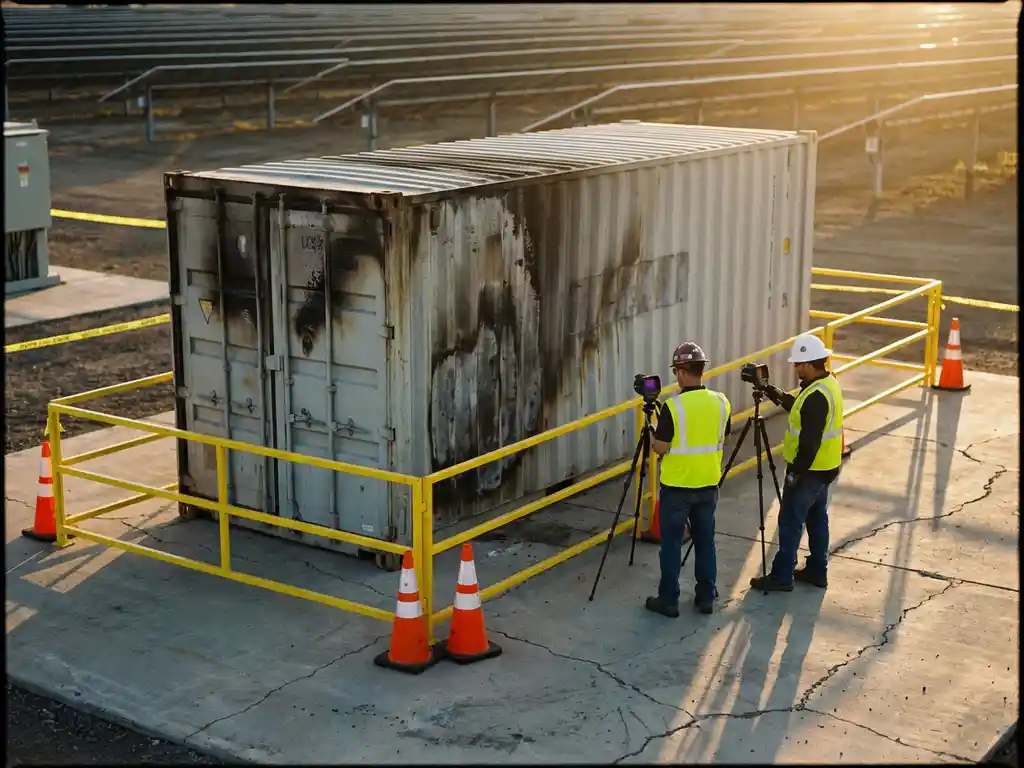
Thermal runaway incidents result in the highest insurance payouts because they can cause complete system destruction, extensive collateral damage, and prolonged business interruption. A single thermal event can propagate through multiple battery modules, potentially destroying entire containerized systems worth millions of dollars while also damaging surrounding infrastructure.
Thermal runaway occurs when battery cells overheat and enter an uncontrollable chain reaction, releasing toxic gases and intense heat. In lithium iron phosphate (LFP) systems, thermal runaway is less likely than in NMC (nickel manganese cobalt) chemistries; however, when it does occur, the consequences can still be severe. The heat generated can exceed 800 degrees Celsius, easily damaging nearby equipment, buildings, and electrical infrastructure.
The financial impact extends beyond direct equipment replacement costs. Business interruption claims can be substantial when storage systems are contracted to provide grid services, frequency regulation, or peak shaving. Some commercial storage installations generate significant daily revenue, making extended downtime extremely costly for operators.
Emergency response costs also contribute to high claim values. Specialized firefighting techniques and extended monitoring periods are often required, as battery fires can reignite hours or days after initial suppression. Water used in firefighting can worsen battery fires due to electrical conductivity and the spread of electrolytes, but it remains the most widely recommended method for cooling and de-escalation, requiring careful coordination with emergency services.
How do performance degradation claims differ from equipment failure claims?
Performance degradation claims involve gradual capacity loss over time and typically require extensive data analysis to substantiate, while equipment failure claims involve sudden, identifiable breakdowns with clear causation and immediate impact. Degradation claims often fall under warranty coverage, whereas equipment failures usually trigger property insurance policies.
Performance degradation in battery storage systems manifests as reduced energy capacity, decreased round-trip efficiency, or an inability to maintain contracted power output levels. These issues develop slowly, making it challenging to pinpoint exact failure dates or causes. Claims adjusters must analyze months or years of operational data to determine whether degradation exceeds normal expectations or warranty thresholds.
Equipment failure claims, by contrast, involve identifiable component breakdowns such as inverter failures, cooling system malfunctions, or control system crashes. These failures typically have clear onset dates and obvious symptoms, making them more straightforward to investigate and settle. The challenge lies in determining whether failures result from manufacturing defects, installation errors, or operational factors.
The documentation requirements differ significantly between these claim types. Performance degradation claims require comprehensive operational data, including charge-discharge cycles, temperature logs, and efficiency measurements. Equipment failure claims require incident reports, maintenance records, and component analyses to establish causation and determine appropriate coverage.
What causes electrical system failures in battery storage installations?
Electrical system failures in battery storage installations primarily result from inverter malfunctions, grid connection issues, control system software errors, and power-conditioning equipment breakdowns. These failures can cause immediate system shutdown and prevent the storage system from providing contracted services, leading to both equipment replacement and business interruption claims.
Inverter failures represent the most common electrical issue in BESS installations. These critical components convert DC power from batteries to AC power for grid connection and are subject to high electrical stress, thermal cycling, and complex control algorithms. When inverters fail, the entire storage system may become inoperable until replacement components are installed and commissioned.
Grid connection failures occur when storage systems cannot properly synchronize with utility networks due to protection relay malfunctions, transformer issues, or communication system breakdowns. These failures can trigger automatic disconnection sequences, preventing the system from operating until grid compliance is restored.
Control system failures involve the sophisticated software and hardware that manage battery charging, discharging, and safety systems. Battery Management System (BMS) failures can be particularly serious, as they may compromise safety monitoring and thermal management functions. Software bugs, communication errors, or hardware component failures in control systems can render otherwise functional storage equipment inoperable.
How do weather related claims affect battery storage systems?
Weather related claims in battery storage systems typically involve flood damage, extreme temperature effects, hail damage to outdoor equipment, and wind damage to housing structures. Unlike solar panels, battery systems are often housed in containers or buildings, providing some protection but creating unique vulnerabilities when protective measures fail.
Flooding poses particular risks to battery storage systems because water intrusion can cause electrical short circuits, corrosion of sensitive components, and potential safety hazards when combined with high-voltage electrical systems. Even minor water intrusion can trigger safety shutdowns and require extensive system inspection and component replacement before restart is permitted.
Extreme temperatures significantly affect battery performance and lifespan. While most commercial battery systems include thermal management systems, prolonged exposure to temperatures outside design parameters can accelerate degradation or trigger protective shutdowns. In some cases, inadequate cooling system capacity during heat waves has led to performance claims and equipment damage.
Hail damage typically affects outdoor components such as cooling systems, electrical enclosures, and monitoring equipment. While battery containers protect the cells themselves, auxiliary equipment remains vulnerable to severe weather events. Wind damage can affect the structural integrity of battery housing and may compromise safety systems or ventilation equipment essential for proper operation.
What documentation is required for successful battery storage insurance claims?
Successful battery storage insurance claims require comprehensive operational data, detailed incident reports, maintenance records, system design documentation, and evidence of financial losses. The complexity of battery storage systems demands more extensive documentation than traditional renewable energy claims, particularly for performance-related issues.
Operational data forms the foundation of most battery storage claims. This includes energy management system logs, battery management system data, charge-discharge cycle records, temperature monitoring data, and efficiency measurements. For performance degradation claims, historical data spanning months or years may be necessary to establish baseline performance and demonstrate deviation from expected parameters.
Incident documentation must include detailed timelines of events leading to system failure, emergency response actions taken, and immediate impact assessment. For thermal events, documentation should include fire department reports, environmental monitoring data, and safety system activation records. Photographic evidence of damage and system conditions is crucial for all claim types.
Financial loss documentation varies by claim type but typically includes revenue-loss calculations for business interruption claims, replacement cost estimates for equipment damage, and additional expense records for emergency response and temporary solutions. For commercial storage systems providing grid services, detailed contract information and revenue projections are essential for accurate loss calculation.
Technical documentation requirements include system design specifications, commissioning reports, warranty information, and maintenance records. This documentation helps establish whether failures result from design defects, installation errors, or operational factors, which directly impacts coverage determination and claim settlement.
How Solarif helps with battery storage insurance claims
As a specialized insurance broker for renewable energy projects, we provide comprehensive support for battery storage insurance claims through our deep understanding of BESS technologies and insurance market expertise. Our team combines technical knowledge of battery systems with extensive claims experience to ensure optimal outcomes for our clients.
Our battery storage insurance claim services include:
- Pre-loss risk management assessment and documentation strategies to strengthen future claims
- Immediate claim notification and emergency response coordination
- Coordination with technical experts for complex performance degradation and thermal-incident investigations
- Business interruption loss calculation and documentation support
- Negotiation with insurers to ensure fair and prompt claim settlements
- Regulatory compliance assistance for environmental and safety requirements
With over 15 years of experience in renewable energy insurance and 521 completed Scope 12 inspections, we understand the unique challenges of battery storage claims. Our established relationships with A-rated insurers and technical experts enable us to navigate complex claims efficiently while protecting our clients’ interests.
Contact our renewable energy insurance specialists today to discuss your battery storage insurance needs and ensure your project has comprehensive protection against these common claim scenarios.
Insurance and inspection needs for your BESS?
Contact us today if you want to know more about the possibilities in BESS insurance and Scope inspections.
📧 Email: support@solarif.com
☎️ Phone: +31 (0)26 711 5050